
The CCE has a central role in Saudi Arabia's climate approach and its announced net-zero GHG emissions target for 2060.
Energy Transition Program 7 Sections33 Lessons5 Days
Carbon Capture, Utilization and Storage
KSA CIRCULAR CARBON ECONOMY
Learning & Simulation Platform
From CCE foundations to Saudi performance, enablers and the Oil Producers Lens.
01
CCE Foundations
Understand the Circular Carbon Economy as the framework that connects mitigation technologies, economic development and Saudi Arabia's net-zero pathway.
Core idea
KAPSARC presents the Circular Carbon Economy as a holistic framework for managing CO₂ and other greenhouse-gas emissions using all available mitigation approaches in ways that are cost-effective, context-appropriate and equitable. A complete CCE balances emissions sources and removals toward net zero.
From a Linear Economy to a Circular Carbon Economy
Explore how value moves from a one-way chain to a closed loop, and then connect the same logic to carbon management.
VIEW THE REFERENCE ILLUSTRATION
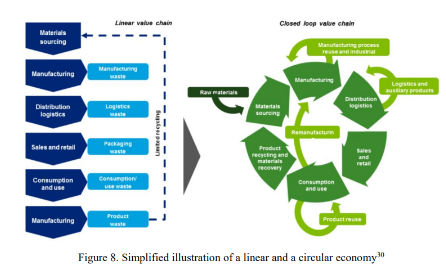
This supplied reference illustration is included as a visual learning aid. The interactive model above has been rebuilt for the course and extends the concept into the Circular Carbon Economy.
From Process Map to Circular Economy Decision Lab
The reference shows what a mature circular ecosystem can look like. Instead of asking you to draw a complex network manually, the Decision Lab builds the system progressively from your strategic choices.
VIEW MATURE CIRCULAR ECOSYSTEM REFERENCE
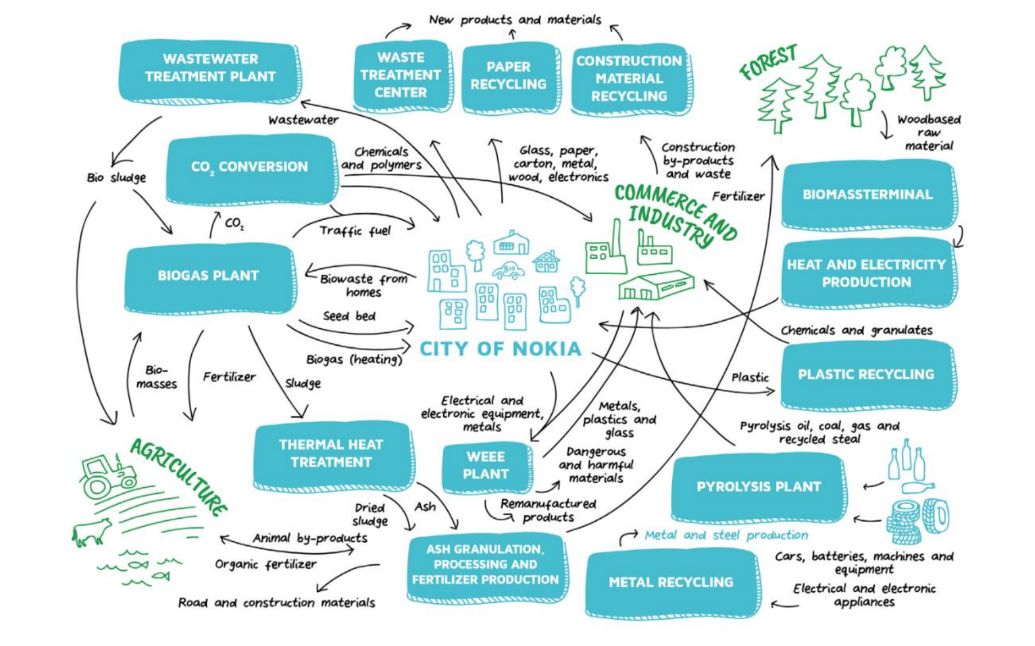
Study the loops, exchanges and recovery pathways. Use VIEW FULL SCREEN to inspect the detailed map, zoom and pan around it, then close the viewer to return to this exact point in the simulator. Your challenge below is to create the logic of an integrated circular system without reproducing this diagram manually. Original external source attribution should be added when confirmed.
Zoom in to inspect individual flows. When zoomed, drag the picture to move around the ecosystem. Close the viewer to continue the Decision Lab.
FOUNDATION DECISION LAB
Jubail Industrial Circularity Challenge
Scenario: A Saudi industrial cluster combines industrial production, power and heat, water services, logistics and a community/market interface. Valuable outputs are currently lost as emissions, heat, wastewater and materials. Build a more circular system while protecting economic value and avoiding excessive system complexity.
Training application informed by KAPSARC's CCE framework (Reduce, Recycle, Reuse and Remove) and its discussion of Saudi CCE performance and enabling conditions. The circular-process illustration was supplied separately as a visual reference and is not attributed to KAPSARC.
The Four Rs
Select each R to see how the principal technologies in the KAPSARC framework contribute.
Why the CCE matters in Saudi Arabia
The framework allows mitigation to be considered alongside economic diversification, energy security, industrial development and well-being.
The approach does not rely on a single solution. Efficiency, renewables, nuclear, electrification, fuel switching, natural sinks, CCUS and clean hydrogen all form part of the performance picture.
Adapted from KAPSARC (2024), pp. 3, 5–7, Figure 1.
02
The CCE Index
Learn how KAPSARC separates what a country is achieving from the conditions that enable further transition.
TOTAL CCE INDEXCountry performance + transition potential
CCE Performance
Eight indicators measuring deployment of carbon-circularity technologies and approaches.
CCE Enablers
Thirty indicators across five dimensions assessing how well the enabling environment supports future progress.
Oil Producers Lens
An additional lens for major oil and gas producers, reflecting transition challenges and opportunities specific to hydrocarbon-producing economies.
Saudi Arabia's 2023 position
2023 Total CCE Index — selected groups
Recreated learning visualisation from KAPSARC 2023 CCE Index results. Higher score indicates stronger combined performance and enabling conditions.
Source: KAPSARC (2024), pp. 6–11, Figures 2–4. Visualisations recreated for training; not reproduced from the publication.
03
CCE Performance
Eight indicators show how Saudi Arabia is deploying the technologies and approaches needed for greater carbon circularity.
How to read performance
A strong score in one technology does not mean the transition is complete. KAPSARC's framework is deliberately multidimensional: progress requires a portfolio of technologies and approaches, supported by an enabling environment.
Source: KAPSARC (2024), Section 3, pp. 12–19; Appendix Figure A.1.a.
04
CCE Enablers
Technology deployment depends on the policy, knowledge, financial, business and system conditions that make implementation possible.
2023 CCE Enablers — selected groups
Saudi Arabia's aggregate Enablers score was broadly on par with the global average in the 2023 Index and above MENA and non-OECD averages.
Decision lesson
A technically attractive CCE intervention can still fail if regulation is unclear, finance is unavailable, the business case is weak, skills are missing or the wider system cannot absorb the change. The Enablers section therefore becomes the bridge between learning and the future application simulator.
Source: KAPSARC (2024), Section 4, pp. 19–27; Figures 7–10.
05
Oil Producers Lens
Examine carbon circularity through the specific operating and industrial realities of a major oil and gas producer.
Why a separate lens?
KAPSARC adds five indicators for major oil and gas producers to reflect the particular efficiency, emissions and industrial-transition challenges and opportunities of hydrocarbon-producing economies.
2023 Oil Producers Lens metric score — selected groups
The paper reports strong Saudi performance on the five Oil Producers Lens metrics, including top scores for carbon intensity of crude-oil production and flaring intensity.
Source: KAPSARC (2024), Section 5, pp. 27–30; Figures 11–12.
06
KSA Transition Dashboard
Bring the learning together: performance, enabling conditions and the Oil Producers Lens provide different views of the same transition.
Established strengths in the paper
- Large CCUS project pipeline
- Progress in fuel switching in the power sector
- Strong business environment and system resilience relative to many peers
- Strong Oil Producers Lens performance
Areas requiring acceleration
- Scale clean-energy deployment
- Increase electrification of industry and transport
- Improve economy-wide energy efficiency
- Strengthen finance and investment conditions for CCE deployment
Forward-looking opportunities
- 50% renewable power-generation capacity ambition by 2030 as cited in the paper
- Scale clean hydrogen
- Develop CCUS hubs and shared infrastructure
- Use policy, finance and innovation to convert targets into implementation
Saudi Arabia — Total CCE Index trend
The 2023 Index shows improvement from 34 in 2021 to 36 in 2022 and 41 in 2023.
Learning conclusion
The KAPSARC framework shows why a single metric cannot describe the transition. Saudi Arabia can simultaneously demonstrate strengths in CCUS and oil-sector efficiency while still needing faster deployment in other clean-energy areas and stronger enabling conditions in selected dimensions.
Source: KAPSARC (2024), Executive Summary; Sections 2–6. Dashboard is a training synthesis created from the paper's reported results.
07
Apply
The application engine will be designed after review of Sections 1–6. It will use the CCE Performance, Enablers and Oil Producers Lens learning base to drive Saudi-relevant strategic decisions.
08
Quiz
The assessment bank will be built from the approved learning content and KAPSARC source material after the learning base is finalised.
09
Results
Results and facilitator debrief will be activated when the Apply and Quiz engines are finalised.
10
Sources & Attribution
The learning base is grounded primarily in the attached KAPSARC discussion paper.
Primary learning source
Aldhuwaihi, Hind & Luomi, Mari (2024). Saudi Arabia and the Circular Carbon Economy: From Vision to Implementation. KAPSARC Discussion Paper, October 2024. DOI: 10.30573/KS--2024-DP36.
The plugin paraphrases and adapts concepts, data and analytical structure for educational use. Charts and diagrams in this plugin are newly created learning visualisations based on reported KAPSARC data; original KAPSARC figures are not reproduced.
Important interpretation note
Reported rankings, scores, targets and project references reflect the source publication and the underlying 2023 CCE Index unless explicitly stated otherwise. They should not be interpreted as a live 2026 status assessment.
Source mapping
| Plugin section | KAPSARC basis |
|---|---|
| CCE Foundations | Executive Summary; Sections 1–2; Figure 1 |
| CCE Index | Section 2; Figures 2–4 |
| CCE Performance | Section 3; Figures 5–6; Appendix A.1.a |
| CCE Enablers | Section 4; Figures 7–10; Appendix A.1.b |
| Oil Producers Lens | Section 5; Figures 11–12 |
| KSA Dashboard | Training synthesis of Executive Summary and Sections 2–6 |